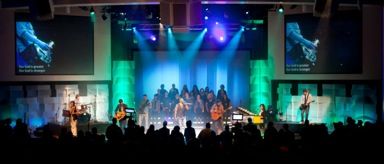
Style of Worship

sundry things…

It’s been a busy week over on the Better Together Facebook page for lead worshippers and those who think about worship in the Covenant. Many things were discussed; I used the word ‘sundry’ above, but now realize that can mean ‘trivial’ or ‘unimportant’. I’ll leave it up to you, dear reader, to make up your own mind how trivial these are.  A brief survey of the topics includes:

Heritage Hymns (“how did you get to be a worship pastor when you don’t know………..?” fill in the title of your favorite Swedish hymn or song)

“when will the HymnBook/Book of Worship be available/searchable online?” Continue Reading »


Strength in diversity

In encouraging fellow worship leaders to sign up and start commenting on the Facebook discussion page, “Better Together”, I don’t think any of us anticipated the breadth or depth of topics that might be covered. Today there are 135 of us from various churches across the Covenant, and the diversity of topics and perspective is amazing. During this week alone, posts ranged from practical issues to deep theology and philosophy.

Examples of the practical side would include:

- what type of instrument and equipment the guitarists use,

- our preference and the acoustic effect of stage platform coverings (more reflected sound from a wooden stage is better for a choir, but for a rhythm section it’s best to use carpeting) and

- the disposition and timing of going to two services, with or without simultaneous Sunday School classes.Throughout these topics, we’re reminded that this forum is populated with skilled musicians and artists who make technical and pragmatic decisions every day, encouraging and enabling ministry through the arts and leading by example. Continue Reading »


Singing and Praying Justice

A powerful reminder that the words we sing matter. As worship leaders we can either promote justice and a multidimensional view of God or myopic materialism – or often something somewhere in between. So much of it is in the words we sing.

http://www.urbanfaith.com/2009/08/singing-and-praying-justice.html

Thanks to Millie Lundgren for the link.

Rooting for you,

Andrew


Remembering Who Our Friends Are (Unsung Song Themes)

Here’s a harder one. But it’s a question that’s been haunting me:

What are some of the important, but relatively distinctive, theological ideas that form the core of who we are as a Covenant church? And how, if at all, are those ideas expressed in song?

I’m not talking about the “we love God” stuff that ever Christian church wholeheartedly affirms – though I know we would affirm that too. Rather, what are the things that together make us distinctly “Covenant?” And are these ideas that express our character, flavor and approach ideas that we ever sing about? Are there songs that, even in part, express these ideas?

Let’s make a list. I’ll start with what I’ve got. You add your ideas to it.

Two rules:
1) Any song you list must be a song your church has actually sung within the last year. Don’t just raid the hymnal index.
2) If you feel you must disagree with someone’s post….please say so nicely.

The Idea:                                 A Song The Expresses That Idea:

Holistic Mission       -     We Are One in the Spirit, Let You Glory Fall, Christ Our Hope Is Here, Lord Give Us Eyes

Priesthood of all Believers    – ??…I’m drawing blanks…ideas??

Freedom in Christ    -     ??? Please, there’s got to be a song… right????

Evangelical but not exclusive      -

Biblical but not doctrinaire – “Ancient Words”

Congregational but not Independent -

Traditional but not Rigid -

I’m surprised by how hard this list is to fill.  Where are the songs that reflect our values? I’ll keep working on my list and developing this idea over the next few weeks. Will you help?

Rooting for you,
Andrew


Telling Each Other’s Story (But NO Anonymous Song Requests)

Allow me to share an idea that’s been helpful in our church. It has done much to lessen the “worship wars” that sometimes happen because of stylistic preferences.  See what you think.
We ask people to recommend songs that “God has used to touch your life.”  People get to request a song that would like the worship team to lead sometime in the future, but each person has to include his or her name. No anonymous song requests. And only one or two songs per person.

At the close of a song (we usually project the lyrics) the congregation would see something like:

“This is one of __________ favorite worship songs.”

For example: (We don’t project the stuff written after in italics…)

“Big House”
This is one of Elizabeth’s Thompson’s favorite worship songs. (Elizabeth is our 5 year old daughter.)

“Because He Lives”
This is one of Bob Floyd’s favorite worship songs. (Bob is our 60 something Leadership Team chair)

There are often a number of names listed after a song.

We’ve found the naming names helps people to see why this song fits for our church. You might not like the song yourself, but if you know that God has used it to touch someone else in the congregation, and who, you get over that more quickly, rather than gripe and complain about how you’re convinced God doesn’t like the song. (It’s amazing how often God hates all the things you happen to hate isn’t it?)

We’ve had services where “In the Garden” is in the same worship set as “Jesus Freak.”  And strangely enough, it fits for us.

Rooting for you,

Andrew


Courtly Love in Worship

Post a Comment » Written on May 11th, 2009     
Filed under: Style of Worship

Scot McKnight posted a short piece about our emotions and affections in public worship. Possibly you are interested. How do you feel about this? I’ve taken inventory of my own feelings after reading the piece, and I think I’m getting old and grumpy: I’m tired of these analyses about public worship.

(btw. I don’t think Scot is pointing his finger at so-called contemporary or charismatic worship. Although, most people in the comment thread at Out of Ur interpreted it that way.) Continue Reading »


Discovering and Escaping Liturgy

2 comments Written on April 21st, 2009     
Filed under: Liturgy, Style of Worship

Ever wonder if it’s really true that the emerging generation likes traditional liturgy in church? Dan Kimball discusses the complications in interpreting the worship preferences of church goers. Check it out.


The Bleak Midwinter

7 comments Written on December 8th, 2008     
Filed under: Music, Order of Worship, Style of Worship, Theology

I’ve heard these reasons for not singing traditional advent music:

  1. The songs are depressing
  2. Most people don’t know they are seasonal, and would not make that connection in worship
  3. The songs are unfamiliar
  4. The Christmas songs are so good, it’s a shame to only sing them once
  5. We already know the end of the story, so it’s no fun to sing about the stuff that’s already happened

What do you think/do about this issue? 


Worship Leader Speak

1 Comment » Written on October 30th, 2008     
Filed under: Articles, Leadership, Style of Worship

Rich Muchow has some interesting things to say in this recent article, A Little Less Conversation: How much should a worship leader talk?

For instance:

I believe my role as a worship leader is to serve my senior pastor’s philosophy of ministry. I trust that the Spirit of God is leading him, and through the Spirit he leads me. That means what I do on the platform should be shaped more by his philosophy of ministry than by my personality or worship style preference.

Also:

… when I lead weekend services at Saddleback, I am free to speak whenever I want for as long as I want. If I feel led to speak, I speak. But it also means my pastor has the freedom to ask me to speak less when he feels I’m going too long.

Any thoughts from this community on the topic of worship leader speak?


More on The Turn

7 comments Written on September 25th, 2008     
Filed under: Church History, Church Year, Culture, Style of Worship
Tags: , ,

This morning, Scot McKnight suggests we respond to the liturgical turn among low church evangelicals, and he offers some particulars in his third post on this topic

Scot thinks, as do I, that this trend is not an invitation to return to the prayers and hymnody of the 20th Century. It’s more complicated than that. He mentions some teaching and preaching approaches that could move us toward a reasoned response to the trend. These take work, thought and creative synthesis. There is no “book” that contains tidy scripts for us to follow. He writes:

Continue Reading »