Scripture

Devotional for a pilgrimage…

Today’s post is written by Geoff Twigg, Adjunct Professor at North Park University in Chicago. Geoff is a pastor, singer/songwriter, worship leader and ministry consultant, and serves the ECC as a member of the denomination’s Commission on Worship.

As we leave the Holidays behind and focus on a new calendar year, Covenanters everywhere across North America see another milestone in the near future; the Midwinter Conference. I’ve had a lot of preparation to do before the Conference this time, and so I have an even greater sense of anticipation than in previous years.

I’m reminded of a great Hebrew tradition, honed by many years of repetition, a tradition that can inspire us as we approach this new year, and particularly if we’re planning to gather together in San Diego. The practice leads us to focus on a subset of the book of Psalms, called the Psalms of Ascents (Psalms 120-134) which form useful devotional guidelines as we consider our pilgrimage.

No, dear reader, don’t worry; I’m not misinterpreting the Midwinter Conference as being more than it is. However, it can be a time when we seek the Lord for new revelations about our practice, or a time of refreshment and renewed spiritual vitality. In fact, I am praying that’s true for each of us, even those pastors and staff who have to stay home so that others can go.

I should, however, mention here that there is a rich offering this year for those involved in worship ministry. We have workshops, conversations planned over lunch, the opportunity to record your own song ideas or talk over how best to approach recording, a full class on worship and the Bible, an open-mic night, a hymn-sing… the list goes on and on. You can sing in the choir, or just ‘chill’ in sunny San Diego.

Meanwhile, back to the point; getting ready to let God re-focus your vision. In this devotional for a pilgrimage, we find a wide range of subjects covered. Be open; any or all of them might have special meaning for you. Here is a cursory analysis of the topics covered, roughly in order. You might care to hear them spoken by a variety of voices:

“It is God who protects and helps us” (I lift my eyes to the hills…), “it’s good to get together to worship God!” (and we pray for peace of our city and our Kingdom).

God shelters us and we’re devoted to God; “we thank God for constant help and protection”, (remember how God helped us in history?). There are reminders that unless the work is established by God it’s all in vain; that despite opposition I’m flourishing through God’s help…

I’m desperate for God, “I trust God as a child trusts”, (remember how David established this special place, and was rewarded?), and a reminder that working together in unity brings a special blessing. We end with a final song of praise in celebration.

This year, when we’re finally at Midwinter, our thoughts will be guided towards God’s preparation of his servants (Ps.139), God’s protection (Ps.46) and the provision of everything we need to do God’s work (Ps.126).

Before we get there, however, would you care to join me as we consider the themes that formed the thinking of believers on pilgrimage to Jerusalem, for many centuries past?


Nothing

Post a Comment » Written on August 3rd, 2012     
Filed under: Bible, Local Church, Scripture, Writing and blogging

Today’s post is written by Matt Nightingale, Director of Worship Ministries at Redeemer Covenant Church in Tulsa, OK.

Tonight I’d like to offer a song. Sometimes music says more than our words alone can communicate, and I’ve been singing this one all week long.

At Redeemer this summer we’ve been making our way through a series called “Sing!” – digging into the songs of the Church. What do the songs we sing say about who we are? About what we believe? How do they form us as believers? So far we’ve preached and sung our way through Isaac Watts’s “When I Survey the Wondrous Cross” (and Matt Redman/Chris Tomlin’s additional new chorus, “The Wonderful Cross”);  “I Am Not Skilled To Understand” by Dorothy Greenwell (re-imagined as “My Savior, My God” by Aaron Shust); and “Forever Reign” by Jason Ingram and Reuben Morgan. And this Sunday we’ll be focusing on another popular contemporary worship song, Chris Tomlin’s “Our God.”

As I was thinking and praying through the lyrics of the song and the scriptures upon which it’s based, I was reminded of another song. It’s been on repeat since Tuesday, reminding me of the awesome love of God in Christ Jesus. And how nothing – nothing! – can separate me from it.

Not death. (Not even the sad, quick death of a fellow staff member here at Redeemer. He found out he had cancer in April. The celebration of his life is tomorrow.)

Not heat and extreme drought. (Tulsa has been suffering for weeks now with highs in the 100s and virtually no rainfall. In the last few days, highs have reached 113 and 114. Records are falling left and right. It’s been miserable.)

Not culture wars and ugly social media self-righteousness. (I don’t know if you have Chick-Fil-A where you live, but here in Tulsa, the only thing larger than the lines on Wednesday were the vociferous opinions on both sides of the “issue.”)

Not busy lives. Not financial stress. Not interpersonal challenges. Not family drama. Not church woes. Not illness.

Nothing.

Nothing can separate us from the love of God in Christ Jesus our Lord.

I can’t embed the video, but head on over to Youtube and take a listen to this awesome reminder. If God is for us, who can be against us?


Don’t Ignore Your Core

5 comments Written on July 29th, 2011     
Filed under: Core Values, Formation, Leadership, Prayer, Scripture, Vocation and Call

Today’s guest post comes to us from Doreen Olson, Executive Minister of the Department of Christian Formation.

If you’re following the trends in exercise and fitness, you’ve probably heard the phrase “core strength.” It refers to the muscles of your abs and back and their ability to support your spine and keep your body stable and balanced. Continue Reading »


Psalm 23 (part 1)

2 comments Written on April 27th, 2009     
Filed under: Church Year, Formation, Scripture, The Psalms

I notice Psalm 23 is the lectionary text for Sunday, May 3. For whatever reason, I’ve come closer to this Psalm in the past year. I’ve been speaking it and praying it almost daily, and I’ve come to experience the language and movements in surprising ways.

I’ve noticed that the Psalm has three distinct settings, and the first one is particularly appealing to me. The outdoor setting of pastures and streams is what first drew me to this Psalm. When I am in trouble emotionally, intellectually or relationally, I long for the peace and tranquility of a walk with God in a green pasture with close sounds of running water.

I remember, years ago, I was under a great deal of stress at the church where I was on staff. It reached the point where I could scarcely sleep on Saturday nights. Sometimes I wouldn’t sleep all night. During this trial, I would recite Psalm 23 over and over in the night. I would remind God: You cause me to lie down in green pastures. You lead me beside quiet waters. Many times I felt my anxieties melt away as God led me out of  fear and into a peaceful place of trust and rest.

I wonder if our ordinary times with God are supposed to be spent in this setting. In fact, I’m reminded that green is the color for “ordinary time.” The other settings of the psalm aren’t so ordinary, but green grass and fresh water are among life’s most ordinary pleasures, and they represent the way life on earth is supposed to be.

The second setting is the valley of the shadow of death. The Psalmist is a realist and recognizes that people don’t always enjoy the ordinary pleasure of pastures and streams, even when we need them the most. When life takes the worst turn, and we find ourselves deep in a rocky, steep ravine, one thing is certain: God is with us. (I’ll reflect more on this tomorrow. The phrase “You are with me” is at the ultimate center of this psalm.)

The final setting is that of a banquet table– and not just any table. At this table, I am God’s guest, and God shows me hospitality in full view of my critics (enemies). Sometimes my worst enemy and critic are: me, myself, and I. This setting reminds me that we enjoy the full favor of God. Even when fellow humans set themselves against us (and even when we deserve to be at odds with others or ourselves because of our mistakes and failures) God is our public advocate and gracious host. As long as we remain in Christ, we are in God’s good favor—part of God’s household—God’s guest in all seasons of life. God is not ashamed of us, and God publicly demonstrates this favor in front of those who doubt us.

Check back this week, and I’ll keep reflecting. Has this Psalm touched your life and thinking? How?


Feast of the Holy Family

Post a Comment » Written on December 30th, 2008     
Filed under: Church Year, Scripture

During Christmas, we think a lot about family. For some, this focus is painful and difficult. We lift you up to the Lord.

For others, it generates joy and thanksgiving.

For the family of Jesus, well, Christmas was an ordeal: An unexpected pregnancy, a long journey at 40 weeks, surprising attention and a startling prophecy.

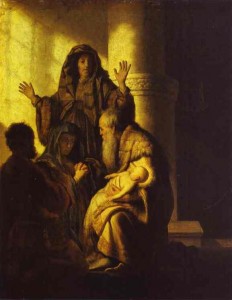
When the day came for them to be purified in keeping with the Law of Moses, they took him [Jesus] up to Jerusalem to present him to the Lord . . . 

Now in Jerusalem there was a man named Simeon. He was an upright and devout man . . . and the Holy Spirit rested on him. It had been revealed to him by the Holy Spirit that he would not see death until he had set eyes on the Christ of the Lord. Prompted by the Spirit he came to the Temple; and when the parents brought in the Child Jesus . . . he took him into his arms and blessed God; and he said: “Now, Master, you are letting your servant go in peace as you promised; for my eyes have seen the salvation which you have made ready in the sight of the nations; a light of revelation for the gentiles and glory for your people Israel.” As the child’s father and mother were wondering at these things that were being said about him, Simeon blessed them and said to Mary his mother, “Look, he is destined for the fall and for the rise of many in Israel, destined to be a sign that is opposed—and a sword will pierce your soul too— so that the secret thoughts of many may be laid bare.” There was a prophetess, too, Anna . . . she had been married seven years before becoming a widow. She was now eighty-four years old and never left the Temple, serving God night and day with fasting and prayer. She came up just at that moment and began to praise God; and she spoke of the child to all who looked forward to the deliverance of Jerusalem.

Luke 2:22-38