BELLEVUE, WA (August 10, 2006) – When you first meet William Deng, you are struck by his eyes. They sparkle with life and are accompanied by a quick, easy smile.
Look deeper into his eyes, however, and one can only imagine what they have seen—unspeakable hardship and heartache.
 Deng was only 10 years old when his life was turned upside down. He returned one afternoon in 1987 from tending to the family farms in the countryside to find his Sudanese village torched and pillaged by government troops, the ominous remnants of a long and brutal civil war that was spiraling out of control.
“I was only a young boy,” Deng says softly. “I didn’t know what was going on.”
His parents, brothers and sisters were gone. So he ran. At first, he was by himself. By the first night, about 50 children had joined him. Within weeks, the total was more than 300. They were part of a growing number of boys ages 5-15 who would later be called by the media the “Lost Boys of Sudan.”
On the ensuing six-month, 1,000-mile journey on foot in sub-Saharan heat and wilderness, he watched his young companions succumb to cruel forms of death—disease, dehydration, starvation and animal attacks.
He witnessed friends being devoured by hyenas and lions. To reach a refugee camp in Ethiopia and later, Kenya, the boys had to forge crocodile-infested rivers, where many lost their lives.
“You had no choice,” Deng said. “You had to cross the river. Boys in front of me went down (taken down by crocodiles) and never came back up.”
An estimated 20,000 boys and girls fled their war-torn villages in Sudan in the 1980s. By the time their treacherous journey to freedom reached the Kakuma refugee camp in Kenya run by the United Nations, the American Red Cross estimated only half of the original group of children were still alive.
“I was lucky,” said Deng, who said he nearly died one day in the desert for lack of water.
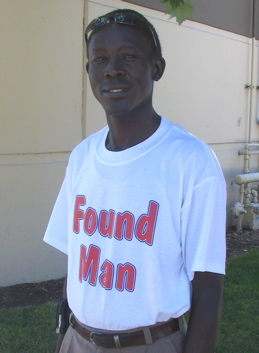
Deng, 29, completed the long journey to the U.S. Now he is on another journey of faith. In more ways than one, he is no longer lost. He wears a tee-shirt that reads, “Found Man” (see top photo). One day, this aspiring minister hopes to return to his native African country to reach the spiritually lost with the good news of Jesus Christ.
Coming to America
Deng spent five years in a refugee camp in Ethiopia. But when the Ethiopian government was overrun by rebels, the Lost Boys were forced back across the border and across the Gilo River, where many drowned, were attacked by crocodiles or shot. They walked to Kenya and stayed there for nine years.
The United Nations intervened in 2001. Many of the boys were resettled in the United States, Canada, Great Britain and Australia. Today, Deng is among nearly 300 young Sudanese refugees living in the greater Puget Sound region.
In December 2003, Deng and three other Sudanese young men —John Wat, Gabriel Yei and David Guet—were sponsored by families of Creekside Covenant Church in Redmond, Washington. Two more were supported by Pine Lake Covenant in nearby Sammamish.
Called the “Sons of Sudan 25:40 Project,” the two-year program was made possible by a Churches Planting Ministries grant and modeled after the scripture in Matthew that says: “I tell you the truth, whatever you did for one of the least of these brothers of mine, you did for me.” (The planting ministries program operates under the auspices of the Evangelical Covenant Church.)
Families from the two churches surrounded the young men with loving arms of support. They invited them into their homes, helped them with schoolwork, car problems, and eventually helped them get jobs and into an apartment.
“It was intense,” said Lynn Fleshman, of Creekside. “We assigned three people to each young man. It was high-level commitment.”
It also was high-level love, an aspect of the program that certainly wasn’t lost on the Lost Boys. “They welcomed us. I didn’t know enough English for them to understand me very well,” says Deng, who now lives in Renton and still occasionally attends Creekside. “But they came alongside us. They made a difference in our lives. They became our brothers and sisters in Christ.”
While the Sudanese men have benefited from the 25:40 project, Fleshman says she received more than she gave. “My measure of success in a day is linked to my culture—completing a project,” she said. “The boys broadened my view of what success is. More so than getting them jobs, helping them be self-supporting, it was the relationships built that was the most important.”
Citizenship
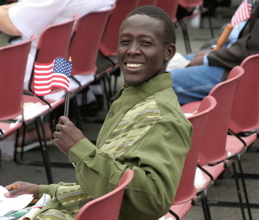
Deng’s journey continues. On July 4 he became a U.S. citizen (see lower photo). He joined more than 500 people from 70 countries at the Seattle Center for the 22nd Annual Naturalization Ceremony. His picture was on the front page of The Seattle Times.
 He received his GED from Highline Community College before enrolling at Bellevue Community College, where he currently is studying and majoring in history. He hopes to transfer to Seattle University and get a degree in theology. Deng wants to be a minister in his Dinka tribe homeland in Sudan.
“It’s in God’s hands,” he said. Hopefully, by 2010, he will have the degree.
The 21-year civil war is over between the southern Sudanese People’s Liberation Army – largely the black African tribes in the south – and the government troops, the Arabs who populate the north and the country’s capital, Khartoum.
The war claimed more than two million lives and uprooted another four million. Only two of his sisters are alive today. His mother and brothers were killed in the civil war. He learned later his father escaped his village in southern Sudan, only to die later from complications from drinking stagnant water.
Deng works for a glass company and sends $100 a month home to Sudan to his sisters. He married in 2003 in Kenya, but his wife, Linda, and her family resettled in Australia shortly afterwards. He has two sons, though he has never met his youngest son. His last trip to Australia was in 2005 and he longs for the day he can be reunited with his family.
Another obstacle to overcome. Another river to cross. William Deng has been shaped by tragedy. But not broken by it. Look into his eyes and you see hope, not despair.
“My message is for hope,” Deng said. “If you’re in deep water, know that hope is on the water banks.”
Editor’s note: this article originally appeared in the North Pacific Conference newsletter and was edited for length.
