CHICAGO, IL (November 24, 2006) – Considered by many the father of liberation theology, Gustavo Gutierrez was honored at North Park University and North Park Theological Seminary last week, suggesting in separate talks that the role of theology must be kept in perspective.
“Theology is a tool,” he observed. “It is a means, but it is not the goal of my life,” Gutierrez told seminary students Friday afternoon. “I don’t believe in liberation theology; I believe in Jesus Christ.”
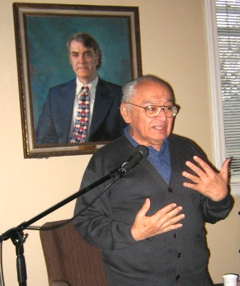 Standing beneath the photo of Karl A. Olsson in the lounge named in honor of the late college and seminary president, the former Peruvian parish priest said, “Theology is made to announce the gospel.” It is not, he added, simply “an exercise in metaphysics.”
Gutierrez’s work, A Theology of Liberation: History, Politics, Salvation, has been considered one of the most important theological works of the late 20th century. He penned the now widely used phrase that “God has a preferential option for the poor.”
Liberation theology has three elements, Gutierrez has written:
• Political and social liberation, which includes the elimination of the immediate causes of poverty and injustice.
• The freeing of the poor and marginalized from all “those things that limit their capacity to develop themselves freely and in dignity.”
• Liberation selfishness and sin, and a re-establishment of a relationship with God and with other people.
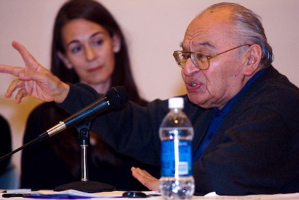
While introducing the theologians, Michelle Clifton-Soderstrom (lower photo), assistant professor of theology and ethics at the seminary, told the 78-year-old Gutierrez that his works are always the most popular among her students.
Gutierrez exhorted the students to “do theology seriously.” Too many homilies and sermons suffer from little theological understanding and an overabundance of anecdotes, he quipped.
Liberation theology, Gutierrez said, is an attempt to answer the question, “How to say to the poor peasants, ‘God loves you.’ ” It was developed at a time of great political unrest and the mass killings and disappearances of people opposed to authoritarian Latin American governments.
Gutierrez often spoke of liberation theology in the past tense, much of its ideals having been enfolded into other ideas, including much evangelical thought. “Theologies are born and die,” he said.
 Many of the new theologians have accepted his idea that when doing theology, “to read from the condition of the poor is very important.
“The great challenge is to be committed to the poor,” Gutierrez continued, using his own life experience to observe that he is not as insignificant in the world’s eyes as he once was. He noted that he is able to see good doctors and eat well.
People should not seek to imitate the poor or feel they have to become marginalized to support the impoverished, Gutierrez advised, but they must practice some form of austerity that keeps them sensitive.
In a different setting, Gutierrez told an audience that packed Hamming Hall that he often is asked whether orthopraxis (right actions) or orthodoxy (right belief) is more important. The two must be esteemed equally, he said.
“If we choose one, we lose both,” he said, likening the question to, “What is more important, eating or sleeping?”
His words “preferential option for the poor” means that no one – not even the marginalized of society – are outside the love of God. This was especially important to announce at a time when the wealthy were viewed as being favored by God.
“Theology must be a prophetic voice,” he said. “We must do and create resources of hope,” adding, “The poor give us opportunity to be disciples.”
University Spanish Prof. Linda Parkyn was part of a panel that responded to Gutierrez’s remarks and the impact of his writings. “I grew up with good orthodoxy,” she said. “The praxis, however, was lacking.”
Her encounters with people in Latin America led her to believe, along with Gutierrez, that the Magnificat (Luke 1:46-55) was as important as John 3:16 and more immediately relevant to the poor.
Gutierrez’s visit was sponsored by the Campus Theme Program and the Center for Justice Ministries.
