By Stan Friedman
CHICAGO, IL (November 10) – Churches must play an integral role to help veterans returning from Iraq and Afghanistan reintegrate into daily life and make sense of their spiritual beliefs in light of what the troops have experienced, chaplains and family members say.
As many as 90 percent of the troops that have been in combat areas will experience some sort of trauma stress while deployed and post-traumatic stress after coming home, says U.S. Army (Major) Chaplain Doug Wootten.
As many as 90 percent of the troops that have been in combat areas will experience some sort of trauma stress while deployed and post-traumatic stress after coming home, says U.S. Army (Major) Chaplain Doug Wootten.
“I don’t want to sound all negative, but we must not pretend, either, that this is a small issue and only affects a small number of folks,” Wootten says.
 Some are like Chaplain U.S. Army Chaplain (Major) Judy Hamrick, who served in Afghanistan and says she still is adjusting to her return home. “I don’t sleep as well right now during full moons. The light wakes me up – that is usually when we were rocketed.”
While Hamrick leans on her faith, others struggle with or even have left faith behind. Dorene Paterson, who attends Lakebay Community Church in Lakebay, Washington, has witnessed one young man – a friend of her son who also is in Iraq – return and discard his beliefs. “He was in Iraq and had just left the mess tent when a suicide bomb went off in the mess tent by Mosul a couple of years ago, and he lost a buddy in that,” Paterson says.
Paterson wonders what her own son’s issues will be when he returns and how she will be able to help him. “I think it will be a challenge,” she says.
There are several myths surrounding returning troops that churches should be aware of, says Capt. James Fisher, who serves as director of operational ministries and chaplain commander for the Naval Surface Force, U.S Naval Fleet. Those myths include:
• They’re crazy now, avoid them.
• Life will pick up from where they left off and go on.
• All returning veterans should fit into the same model of care, carry the same internal issues, heal at the same rate of time.
• The relationships with wives and kids will get “back to normal.”
• Everyone has PTSD (Post-Traumatic Stress Syndrome).
• They’re crazy now, avoid them.
• Life will pick up from where they left off and go on.
• All returning veterans should fit into the same model of care, carry the same internal issues, heal at the same rate of time.
• The relationships with wives and kids will get “back to normal.”
• Everyone has PTSD (Post-Traumatic Stress Syndrome).
Although myths abound, many troops will face major issues, Fisher advises. Issues of trust loom large, and troops will wonder, “After experiencing the worst of the human condition and mankind, who can I trust with my story and soul?” It is important to note, too, that recovery only happens in a supportive community. They also will face tough questions: Will my efforts be appreciated and honored? Can I be absolved and purified after spilling another’s blood?
 Army Chaplain’s Assistant Tim Dunkin says he frequently worked with soldiers while in Mosul to deal with the fact that they had killed someone. He would tell them, “This is war. This isn’t who you are. This is what you do.” To read a more personal account of Dunkin’s experience, please see How War Changes Life.
In an interview on National Public Radio, Chaplain John Morris, a non-Covenant chaplain in the National Guard, said issues are different for Guard members, who may serve in combat longer than active-duty soldiers.
“We take a citizen off the street of Minneapolis, and we turn them into a warrior, a person who, upon demand, without a split-second hesitation, will point a weapon at another human being and shoot them until they don’t get up again,” Morris says. “It takes six months to get a person ready to do that, and then we put them in combat for 12 months. Then, in 300 hours, we can have them from their last mission back on the street in Minneapolis in their civilian clothes. There’s a problem there.
“The active duty doesn’t do that,” Morris observes. “They bring their soldiers back to bases, they have a transition period, they have programs, they watch their soldiers. We just release them. And how do you reverse from warrior back to citizen in 300 hours? It can’t be done, and it’s not being done well around the country.”
Chaplains say churches also must be sure to care for families while the soldiers prepare to leave and serve as well as when they return. For suggestions on how churches and individuals can assist returning soldiers, please see Veterans Checklist.
Covenant minister and Chaplain (Capt.) John Grauer wept when he called his family to inform them that he will not be coming home from Iraq as planned, but will be redeployed to Baghdad.
Grauer’s nine-year-old daughter Morriah started crying when she heard the news. “That’s when I put the sunglasses on” so others would not see the chaplain doing the same, he told Michael Hastings, who wrote an article in the current issue of Newsweek magazine about the sudden change of plans for the brigade in which the chaplain serves.
“Family members and loved ones have lived some or a lot of this trauma, pain and suffering through stories, emails and phone calls, as well as R&R (rest and recreation) times when they return to the family for a couple of weeks and then go back to the war zone,” says Wootten. “Loved ones can actually develop their own post-traumatic stresses, in a sense, alongside the one close to them who has come home from the global war on terrorism.”
Linda Anderson credits a miracle with saving her son, Chris, but still lives with the fact that he was nearly killed. Chris served as a U.S. Army sniper from September 2005 to March 2006.
Before leaving overseas, he received the gift of a laptop that he planned to use for communicating home and taking a college course. Leading a small patrol with all his gear in the backpack, he was shot while turning a corner into a dark alley and went to the ground, Linda says. “As his fellows ran to his aide, he could feel warm liquid running down his back. The backpack was removed to find that the bullet had passed through his canteen of warm water and lodged in the laptop! He was uninjured.”
In January, her son will redeploy to Iraq. She can only pray that the Lord will continue to keep him safe.
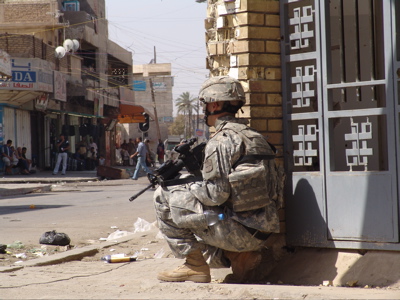
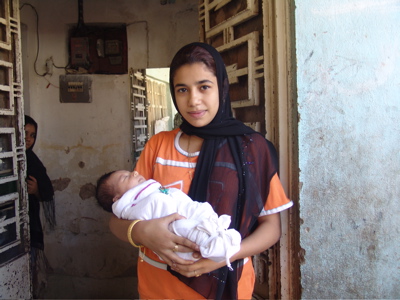
Editor’s note: the top photo provides a sense of the danger that soldiers face on a daily basis in Iraq – photos by Chaplain John Grauer. The lower photo shows a a 14-year-old girl in Baghdad, one of the many requiring humanitarian assistance.
Copyright © 2011 The Evangelical Covenant Church.
