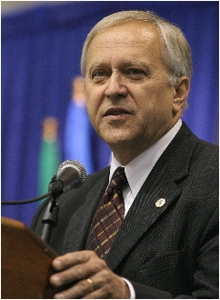
 Palmberg was asked to address questions surrounding the State Children’s Health Insurance Program (SCHIP), which Congress voted to reauthorize, but President Bush vetoed. Lobbying efforts are under way with certain members of Congress to secure enough support to sustain a veto override vote in Congress.
The bill, approved by Congress with bipartisan support, would expand SCHIP to cover an estimated 10 million children – some 6.6 million children are currently covered by medical insurance.
The measure would provide $60 billion over the next five years, $35 billion more than current spending and $30 billion more than the president proposed. The President and his supporters argue that the bill would be a step toward federalization of health care, and that it would steer the program away from its core purpose of providing insurance for poor children and toward covering children from middle-class families, according to a New York Times article.
The program was to expire on September 30, but financing for it has been continued through a stopgap spending bill that will be in effect through mid-November.
In response to a question on why religious organizations are speaking out on this particular issue, Palmberg observed, “When an issue like this comes up, there’s not an opportunity to take a vote in the Evangelical Covenant Church. So I speak for myself. I can’t speak for the individual churches. For an evangelical denomination, we’re fairly involved.
“There are some groups that have no advocacy unless the churches become advocates,” Palmberg told reporter Anne Farris in Monday’s interview. “That’s why I think it’s important that the church express itself when it’s an issue that we think has moral implications. We are there to make sure that politicians know that we’re paying attention, we care and we vote.
“I believe scripture is clear that government has a role to play,” Palmberg noted. “So we’re there to advocate for people who often don’t have an advocate and to ensure that government responds to its appropriate role in society.”
To read the complete online interview, please visit Roundtable and SCHIP.
