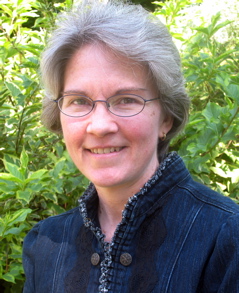
SIOUX CITY, IA (October 2, 2007) – Massage therapist and spiritual director Sue Radosti says it makes perfect sense to combine her two vocations.
“Both vocations blend into one ministry of health,” says Radosti, a member of the Evangelical Covenant Church in Wakefield, Nebraska. “Both have physical and spiritual aspects. Both may involve words or silence. Both deepen people’s awareness of their need for transformation and healing.”
Radosti says combining the two also is especially fitting for Christians. “So many people in the field are so out there with the Eastern philosophy, and yet we are the one with the incarnational theology,” she explains.
Spiritual direction is a process by which directors help directees discern and respond to the movement of God in their lives. Generally, the sessions are done in a room set aside for this purpose.
 But people making an appointment with Radosti also can elect to have the massage and do the spiritual direction at the same time. A recent session incorporated times of silence, prayer and scripture.
Not only did the directee appreciate the experience, “It was very powerful for me,” says Radosti, explaining that the session gave her an even deeper appreciation for the dignity of the person on the table.
Radosti knows people may have a hard time understanding the combination. “I wish there was one word for what I do – a word that makes an obvious connection between massage and spiritual direction,” Radosti reflects. She still is unsure how the pairing will evolve over time.
In August, Radosti was among the first class of students to graduate from the Center for Spiritual Direction operated by North Park Theological Seminary and funded in part by a $1.6 million Lilly Endowment grant for the Sustaining Pastoral Excellence program (SPE).
She first enrolled in seminary in 1999 when North Park inaugurated its distance learning program with an online course in small group ministry. Because Radosti was involved with small groups in her church, she jumped at the opportunity to learn new skills.
The course, however, stirred a desire to examine her faith in relation to her chosen vocation of massage therapy. When North Park introduced a new degree concentration in faith and health the following semester, Radosti was among the first to apply.
In what became a familiar routine of online classes and summer intensives, Radosti spent six years completing her Master’s Degree. She says the coursework deepened both her spiritual understanding of health and her appreciation of the church’s ability to nurture health and wholeness.
Radosti often was the only student in her classes who wasn’t either a prospective pastor or a nurse with an interest in parish health ministries. “I was never sure,” she admits, “whether I was preparing myself for a new vocation, or whether I was becoming a new person in the vocation I already practiced.”
Meanwhile Radosti wasn’t the only one in her social circle who was doing “the seminary thing.” One of her best friends was simultaneously studying spiritual direction at Creighton University. Although the concept of a spiritual director was new to Radosti, she was intrigued by the similarities between her friend’s task of nurturing spiritual wholeness and her own vocation of facilitating physical healing.
“She would tell me, ‘Sue, you’ve got all the gifts to be a spiritual director,’ ” Radosti recalls. “I would always say, ‘Yeah, yeah, that sounds great, but I’ve got this degree to finish.’ ”
But just weeks shy of her 2005 graduation from the seminary, the school announced another field of study – the training program in spiritual direction.
Radosti says she hesitated to tell her church that she was applying for two more years of schooling. But when she was admitted to the new program, her congregation provided a scholarship so that she could graduate with no tuition debt.
She dreams of eventually establishing an ecumenical retreat house, where both massage therapy and spiritual direction would naturally fit into the larger picture of rest, renewal, and Christian hospitality.
