By Bob Smietana
CHICAGO, IL (September 13, 2007) – It was a flight that Martin Marty would never forget.
Marty, the famed University of Chicago professor of church history, was returning home from a speaking engagement in California some years ago, and had settled in with a pile of books on the seat next to him. Before he could start reading, a woman sat down on the other side.
“Are you religious?” she asked, looking at his books. When Marty replied, “yes,” she said, “Well so am I.” Then she began to describe her own faith. She was a member of a local Christian church but also believed in reincarnation, practiced yoga, and embraced any other “spirituality” that came her way.
“By the time the flight landed, we’d been through the whole encyclopedia of religion,” Marty recalled while speaking at Anderson Chapel at North Park University in Chicago last night.
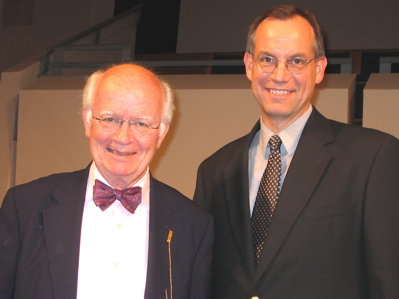 Marty, the Fairfax M. Cone Distinguished Service Professor Emeritus of the History of Modern Christianity at the University of Chicago, was at North Park to address this year’s campus theme, “What is the life of faith?” He was asked to address the issue of pluralism and Christianity or, as he put it, “What is the life of faith amidst all the other faiths?” (The accompanying photo shows Marty, left, with Stephen Graham, dean of faculty at North Park Theological Seminary.)
His conversation on the airplane showed one of the downsides of pluralism, Marty said. In a nation of many religions, it’s easy to dabble in many faiths and never commit to one. But that kind of spirituality has little value.
“You can dabble in faith, but that doesn’t satisfy,” he said. “It doesn’t do anything for you at three o’clock in the morning [during a crisis] or when you get a diagnosis of cancer.”
Other Faiths Can Be Beneficial
On the other hand, encounters with other faiths can be beneficial. For example, Marty said, the environmentalism of other faiths has sent evangelical Christians back to the Bible, where they have read Genesis with new eyes. “Other faiths send us back to our own book to see what has been obscured,” he said.
Marty told how an encounter with a Muslim scholar made him see his faith with new eyes. While working on the Fundamentalism Project, he visited Jerusalem and was taken to the Dome of the Rock mosque. There he saw a stone with a hoof print on it, where, according to Muslim tradition, Mohammed’s horse stepped before the prophet ascended into heaven.
“Back at the hotel that night, I told the story to my colleagues and had a good laugh,” Marty said. “I said, ‘They actually believe a horse took off from a rock and went to heaven – that’s how weird they are.’ ”
The next day Marty went to the Mount of Olives and saw a stone commemorating the ascension of Jesus. He realized that his Muslim colleague would be equally puzzled that anyone could actually believe that Jesus ascended into heaven. (The physics of Jesus’s ascension had never quite occurred to Marty, who for many years attended Ascension Lutheran Church in Riverside, Illinois.)
Marty, who was a Lutheran pastor and church planter before becoming a seminary professor, encouraged his audience to learn from other Christian traditions as well. He recalled attending Chicago’s Gospel Fest one year, at the invitation of a city official. Having grown up in a liturgical church, Marty said he felt out of place at first. Then he was caught up in the music and praise and had a change of heart.
“With the traditions and life of faith we feed each other until it becomes so natural we hardly notice it,” he said.
Religious Freedom Helps Faith Thrive
Although some evangelical Christians view pluralism with suspicion, Marty argued that it creates an atmosphere for faith to thrive. In the U.S., he said, faith thrives because of religious freedom. In Europe, the establishment of state churches sapped energy from the faith. Recalling a speech he’d given once at a Mormon university, Marty said that a “godless constitution”—one that did not establish a state church—made a place for “godly people.”
“People are more vitally engaged in a faith that they choose than they are if they passively accepted the faith handed down to them,” he said. “Freedom of religion is the great gift Americans gave to each other.”
Using a quote from Voltaire, Marty pointed out that having many faiths can create conditions for a more humane society. After visiting England, Voltaire wrote, “If there were only one religion in England, there would be danger of tyranny; if there were two, they would cut each other’s throats; but there are thirty, and they live happily together in peace.”
Still, being uncomfortable with people of other faiths is an American tradition, Marty admitted. He pointed out that few of the early settlers were interested in religious freedom for all. Instead, they wanted to establish their own faith as superior.
So in 1654, when a group of Jews fleeing from Brazil landed in New Amsterdam, the Dutch Reformed Governor Peter Stuyvesant, wanted to send them away. If he let them in, Stuyvesant believed, then he’d have to let in other Protestants and Catholics and soon the Dutch Reformed dominance of the new colony would be lost. Stuyvesant was eventually forced to let these strangers from another faith settle in New York. Tongue in cheek, Marty said, “That was the beginning of the American phrase, ‘There goes the neighborhood.’ ”
Pluralism Here to Stay
In 2007, Marty added, pluralism is here to stay. He pointed to a 1965 change in immigration laws, which opened up the U.S. to immigrants from Asia. “It changed everything,” Marty said. “There is no place you can hide. Pluralism is here to stay with a great deal of vigor.”
Taking on another controversial topic – tolerance – Marty had two responses. “The good part of tolerance is that nobody dies,” he said. The downside is that tolerance can mean watering down faith into meaningless relativism or dabbling.
He also took on those who argue that the world would be better off without religion. He noted that the biologist Richard Dawkins, author of The God Delusion, has argued that the world will be a wonderful place “once we get rid of all religions.”
“But we’ve just spent a century trying to get rid of religion and 100 million lives were lost (in the process),” Marty said. “Every major totalitarian regime has tried to abolish all religion or to promote only one true religion – but religion of all kinds is still thriving.”
Marty pointed out that in some ways, competing for followers makes religions more creative and vital – and added that some established Christian churches might do well to learn from new faiths.
For example, he said, “Mormon missionaries are trained to make 1,500 house calls before finding one friendly response.” By contrast, “Episcopalians invite someone to church – which is generally the way people are first introduced to faith – every 29 years.”
“So the Mormons have a little bit of an edge,” he said.
