MOUNT VERNON, WA (November 22, 2006) – The lure of the Skagit Valley can be hard to resist.
It draws tourists from around the world to its stunningly colorful tulip fields in April, outdoor enthusiasts to the mighty Skagit River and majestic North Cascades mountains, and retirees and families weary of the break-neck pace of living in the greater Seattle area.
 This fertile valley 60 miles north of Seattle has also become a popular destination for people from a land 2,000 miles to the south. For many years, thousands of farm workers from Mexico have been drawn to the agricultural-rich Skagit Valley, where they work in the farm fields and fish processing plants, as well as restaurants and construction.
That stream of people migrating from Mexico to the Skagit Valley has widened in recent years, like the swollen Skagit in flood season. The percentage of Hispanics in Skagit County has nearly tripled in the past 16 years, from 5.4 percent of the population in 1990 to 13.1 percent in 2005.
That growth has occurred at an even more rapid rate in Mount Vernon. While fathers, and in many cases mothers, are gainfully employed, the children need care, which is where Bethany Covenant Church is stepping into the gap.
The church in September launched an after-school program called the “Children of the Valley.” A paid staff of three and a group of volunteers work with students grades 1-6 after school on Mondays through Fridays. They help kids with their homework, help hone reading skills, and provide learning activities and nutritional food.
“We want to offer a program that any parent would want their child to be involved with after school,” says Ken Wagner, Bethany’s associate pastor who helped get the program started. “One that is safe, well-supervised, that offers healthy food and caring adults to help with homework.”
The program is designed for kids whose families qualify for the free or reduced lunch program in the public schools. That means the kids who attend Bethany’s after-school program often are from the poorest families in the school district.
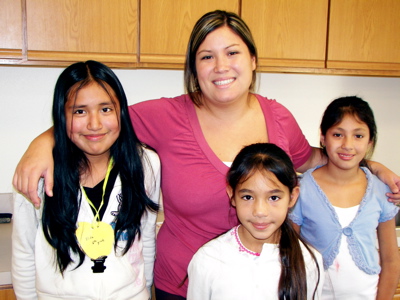
While “Children of the Valley” is open to kids of all ethnic groups, the 26 enrolled in the program as of mid-October were all Hispanic. That makes the director of the program, Flora Lucatero, uniquely qualified to launch this significant ministry. (The top photo shows Flora with a group of the children.)
 One of five sisters, Lucatero is a member of a well-known Hispanic family in Mount Vernon. Her mother has been a counselor at Mount Vernon High School for several years, her father a professional photographer. Her grandparents were migrant farm workers from Mexico who traveled between jobs in Florida, Texas and California.
“She viewed this job as something that God provided for her,” Wagner said. “We viewed this as God providing her for us.”
Lucatero, who is bilingual, has already put her stamp on the program with her enthusiastic leadership style. “I love it,” she said. “God has blessed me with helping provide for people most in need. I’m getting paid to help others. It feels good.”
After having been gone a few years, this is not the valley Lucatero remembered as a child. Flora and her sisters attended Centennial Elementary School in the early 1990s. Back then, they stuck out.
“We were one of the first Hispanic families in the school back then,” she said.
Fast forward to 2006, and the demographics of Mount Vernon’s schools have changed dramatically. Today, Centennial is 75 to 80 percent Hispanic. About 75 percent of students at Centennial qualify for free or reduced lunch. At nearby Madison Elementary School, 85 percent of the students qualify for the subsidized lunch program.
 “Children of the Valley” was jump-started by a $10,000 Churches Planting Ministries grant from the North Pacific Conference of the Evangelical Covenant Church. Earmarked for non-salary items, the grant will pay for ministry expenses such as new computers, tables, desks and a remodeling of the kitchen to meet the requirements for a federal food program, which will reimburse Bethany for the cost of snacks. The program also recently received a $500 grant from the conference’s Covenant Women’s Ministries.
Bethany’s congregation has been an enthusiastic supporter of the after-school program. A $39,000 budget for the first year was passed unanimously. But the church hasn’t just offered financial support. More than 50 Bethany Covenanters signed up to help volunteer, and 30 people showed up on a weekday afternoon in early September for a training session.
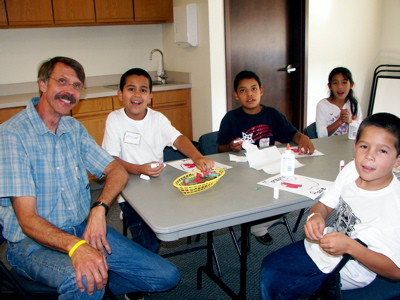
Several of the volunteers are planning educational activities beyond tutoring (center photo). One man in the congregation wants to teach a woodworking class. Another who directs a bell choir in the valley wants to lead a music chime choir. Volunteers include doctors and accountants.
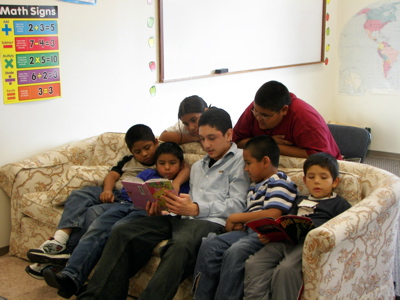
Kristi Byford, the activities director, and Jerry Alvarez, a high-school student who is bilingual, assist Lucatero. Since many of the kids speak little English, Flora says the biggest challenge is finding bilingual tutors to help with reading (lower photo). But progress is being made.
“Some of the kids at first were shy and too timid to read,” she said. “But we see progress. One boy, when he came the first day, wouldn’t read at all. Now he reads an entire page of a book at a time. For many of them, they just need that extra self-esteem. We push for them to be determined, to have a positive attitude.”
Hispanic families in the Skagit Valley are here to stay. Years ago, they came just to work, often returning to Mexico, California or Texas once harvest time was over.
Economics drives them north. Many migrant workers come from Oaxaca, the second poorest state in Mexico, where a man who earns $16 a day as a construction worker can make up to $10 an hour picking berries at Sakuma Brothers Farms in the Skagit Valley. Hispanic workers have buttressed the work force that keeps the county’s $600 million agricultural industry running.
But language barriers, educational opportunities, and affordable housing are just a few of the obstacles that await Mexican immigrants north of the border. And that’s where Bethany Covenant wants to extend a hand.
“We want them to know that they are loved by God no matter what, and we want to help them break the cycle of a generation of poverty,” Wagner said. “And that means caring for them in tangible ways, to succeed in schools, because we believe education is essential.
“We can talk a lot about the fact that God loves you,” Wagner continues. “Harvey Drake (with whom Wagner served at Emerald City Bible Fellowship in Seattle) used to say there’s a need for proclamation and demonstration of the good news. And that’s what I believe this after-school program is all about.”
(Editor’s note: Rick Lund is a member of Bethany Covenant Church in Mount Vernon, Washington. He serves as editor of the North Pacific Conference News.)
