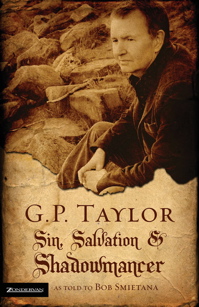
Smietana co-authored G.P. Taylor: Sin, Salvation and Shadowmancer, which recounts the remarkable twists in the life of Graham Taylor, who once was a roadie for punk bands such as the Sex Pistols, and later became a police officer and then a vicar in the Anglican Church. To listen to Bob share one humorous moment during his time with Taylor, click on
 Midnight at the BBC.
 No one foresaw the huge commercial success or that critics would compare the series favorably with the collection surrounding a young lad named Harry Potter. The allegories of good versus evil proved popular with Christians who found the J.K. Rowling collection unpalatable.
Covenanters have long been familiar with Smietana’s award-winning work in the Companion. He is a frequent contributor to Christianity Today and Religion News Service (RNS). His articles also have appeared in the Washington Post, Los Angeles Times, and the Chicago Tribune.
Covenant News Service sat down with Smietana to discuss his first book project.
How did you get involved with this project? How long did it take?
It’s actually all Harry Potter’s fault. I was ordering the British version of Harry Potter and the Order of the Phoenix when a window popped up saying, “If you like Harry Potter, try Shadowmancer.” On the spur of moment, I ordered that, too. It sat on my shelf for a few months, and then a friend from church borrowed it, so I didn’t get around to reading the book for a long time.
When I read it, I was hooked. I wanted to know more about the author, G.P. Taylor. It turns out, he was an Anglican priest from Yorkshire with a dodgy background who’d sold off his motorcycle in order to publish the book. The more I read about his faith story – how he’d been a teenage runaway, become a Christian and then been a policeman and later a priest – the more I was intrigued. When I heard he was coming to the States, I emailed him, again on the spur of the moment, to see if we could interview him for the Companion.
We hit it off during that initial interview, and that led to writing stories about Graham for other publications – Religion News Service (RNS), Christianity Today, Episcopal Life – and then to the book. It was one of those surprises that God springs on us sometimes.
You traveled to England and spent several weeks with Taylor. What was that like?
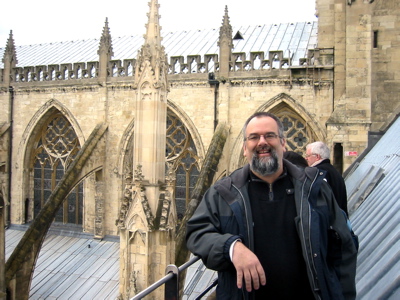
It was brilliant, absolutely brilliant. I got to chase around Scarborough, Graham’s home town, visited the York Minster (top photo), the largest gothic cathedral in Northern Europe, ate fish and chips fresh from the North Sea, and even ended up appearing for about five minutes on BBC radio with Graham. He and his wife, Cathy, were gracious hosts, and I had the time of my life getting to know them.
Taylor’s story seems so improbable. What about him intrigues you the most?
Graham seems to keep stumbling into the most amazing scenarios. Once, when he was a new minister working in Whitby (where Bram Stoker’s Dracula is set), he was asked to preach a sermon that would be televised nationally. Since it was near Easter, he wanted to preach on the crucifixion. The network thought that was “too violent for television” and asked him to preach about boats instead. He refused and pulled out. Next thing he knows, a reporter from one of the London papers is on the phone, wanting to know about “the sermon too violent for television.” The sermon ended up being reprinted by the local paper and by several newspapers overseas. That kind of thing happens to him all the time.
All these things happened by him taking very small steps of faith, one a time, and watching God do all these remarkable things. Plus, despite all his success, he’s a regular guy. Even after he’d signed a deal with Hollywood for the film rights to Shadowmancer, he still drove a beat-up 1980s vintage car.
Did Taylor set out to be “The Christian Harry Potter?”
Not really. He was actually more concerned about the works of Philip Pullman, who’s been described as the “anti-C.S. Lewis” for writing an epic based on Paradise Lost, where God is a senile liar and the devil is the hero. That series of books, called “His Dark Materials,” is immensely popular.
 Graham wanted to offer an alternative, something filled with swashbuckling adventure, but also offering a glimpse at a story where God is real and involved in the lives of characters. He didn’t want to write a Christian book. He did want to follow the example of C.S. Lewis and Tolkein – weaving God into an adventure. But the story came first, and that’s why, I think, it captured people’s attention.
Right now he’s on a book tour in local schools, bookshops, and libraries talking about The Curse of Salamander Street, a sequel to Shadowmancer. He talks about writing, tells stories from his life, and captures the imaginations of the kids he talks to. He’s really earned the right to be heard by being a storyteller first.
You have written about people. How difficult was it to write in the first person when that person was someone else?
Do you have any favorite stories from the book?
There’s a very funny story about him chasing a fox through his neighbor’s yard in the middle of the night – the fox had killed his chickens – and then realizing he was in his underwear. Just as he turned to run home, the milkman drove up his neighbor’s driveway. He dove into the bushes to hide and thought he’d escaped unnoticed. The milkman drove up, waved, and shouted out a cheerful, “Morning vicar,” as he rode by. Those sorts of things are pretty common for him. Sometimes I felt like I was writing something out of the Vicar of Dibley or Monty Python.
The section on how he came home broke, after running away to London to seek his fortune, and being welcomed home like the prodigal son by his mother was very powerful. At several key points in his life, when he was lost or very ill, people reached out with small acts of kindness and in those moments, he really felt God’s presence made real.
Why is his story important to tell? What do you hope readers will take away from the book besides knowing more about its subject?
A couple of things. I hope they enjoy the story because it’s great fun. I feel like Larry the Cucumber, who once said in response to a VeggieTale episode, “I laughed, I cried – it moved me.” This story is like that, a rollicking adventure of God’s grace.
When he was in seminary, Graham read a book called The Sacrament of the Present Moment, about living each moment as if you were really in God’s presence – instead of constantly thinking about what will happen next. That book, which he said was the only book he enjoyed reading in seminary, shaped his life in some powerful ways. He always seemed to treat people like they were the most important person in the world when he was with them, at least during my visit.
Graham’s seen God at work in both the joys of life and the trials of life. Not long after he became a bestselling author, he became very ill and near death on several occasions. And he really had to rely on God in those moments. He also had to realize as a pastor that he could fail, and God would still love him – that God’s love wasn’t dependent on Graham’s success or failure as a pastor.
It’s about hope, joy, and God’s love over the long haul in the life of messy Christians.
Diane Louise Jordan, who’s a television presenter on the BBC, wrote this blurb for the book, and I think she summed it up better than I could.
She wrote: “Graham’s story is a vivid reminder that nothing can separate us from the love of God. Nothing. Not anger, not failure, not illness, not success, not church hypocrisy, not excessive rock and roll – nothing.”
Editor’s note: to order a copy of the Graham biography from the online Covenant Bookstore, select either Hardcover or Softcover versions.
